
 India
 UAE (Dubai)
 Australia
 Philippines
 Thailand
 Malaysia



 Calendar Management
 Staff Management
 Inventory & Stock Mgt
 Web Mobile App
 Business Dashboard
 Billing & Invoicing
 Multi Branch management
 Integrations
How to Start a Dog Daycare and Boarding Business: Costs, Licences, Business Plan and Daily Operations

11 mins Read
Nov 11, 2026

Share

Starting a dog daycare or boarding business takes six things. You need a safe premises with indoor and outdoor space. You need the licences your area requires. You need insurance. You need written intake and vaccination rules. You need trained staff. You need a booking system that tracks capacity.
Costs depend on your country, your size and your fit-out. Later we show how to build your own budget.
This guide is for people who plan to open. It covers costs, licences, plans, policies, staff and systems. We cover India, the UAE, Australia, Malaysia and the Philippines. Rules differ by country.
Daycare, Boarding or Both: Choose Your Model

Your model sets your space, staff and income pattern. Pick it before you look at premises.
- Daycare only: Dogs arrive in the morning and go home at night. You need play space and close supervision. Demand usually follows the work week.
- Boarding only: Dogs stay overnight. You need kennels or suites and night care. Demand often peaks around holidays and school breaks.
- Both: Daycare fills your weekdays. Boarding fills holidays and weekends. You share space and staff. So you need clear rules for each.
- Home boarding: Dogs stay in your own home. Costs are lower. Local zoning and capacity rules may limit home setups. Your space caps your growth.
Unsure? Start with one service. Add the second once the first runs well.
How Much Does It Cost to Start a Dog Daycare?

No neutral body publishes startup totals. So treat every figure as a rough guide. We found one published estimate. It comes from MoeGo, it puts a home daycare at $5,000 to $25,000. It puts a small facility at $50,000 to $150,000. These are US dollars.
Use these only to set a first budget. Then get local quotes. Ask for rent, build-out, flooring, fencing and insurance.
What to put on your budget sheet
- Rent and deposit
- Build-out and repairs
- Flooring and fencing
- Kennel runs or suites and dividers
- Cleaning supplies and drainage work
- Insurance
- Licences and permits
- Staff hiring and training
- Booking and billing system
- Launch marketing
- Cash for the first few months
Licences and Permits by Country

Rules differ by country, state and city. Confirm with your local authority before you sign a lease.
India
The Dog Breeding and Marketing Rules, 2017, apply in India. They define a breeder to include a boarding kennel operator. So you may need State Animal Welfare Board registration. Some states add rules of their own. Tamil Nadu, for example, has a pet boarding policy. Ask your State Board what you need. Also ask your local civic body.
United Arab Emirates
Rules differ by emirate, and they are changing. Our UAE pet laws guide explains the shift. In Dubai, start with Dubai Municipality's Veterinary Services section. Ask which permit your premises need. Do this before you sign a lease.
Australia
Each state sets its own rules. In Victoria, boarding businesses register with their local council. Councils count day cares and overnight boarding. Registration renews every year, by 10 April. Other states have different rules. Check your state agriculture agency and your council.
Malaysia
Malaysia's Animal Welfare Act 2015 covers Peninsular Malaysia and Labuan. Sabah and Sarawak follow their own laws. The Department of Veterinary Services now licenses animal boarding. Our Malaysia licence guide covers the steps.
Philippines
Boarding facilities register with the Bureau of Animal Industry (BAI). One regional office lists ₱300 for the first year. Renewal is ₱900 for three years. Fees can differ by office. Our BAI permit guide has the full steps.
United States
Rules vary by state and city. Check zoning, your business licence and any animal permits. Inspections may apply. Ask your city or county first.
Premises: Space, Layout and Safety
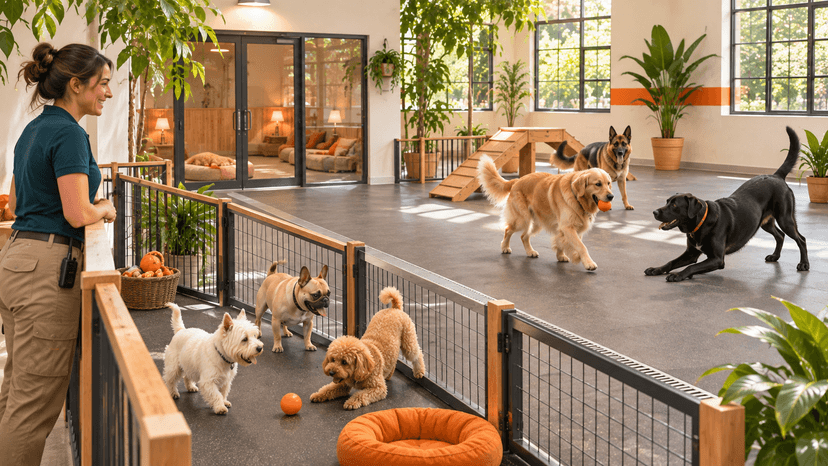
Your premises set your safety and your capacity. Ask these questions before you sign a lease.
- Is the site zoned for dog daycare or boarding?
- Can you keep dogs apart by size and temperament?
- Is there a quiet room to isolate sick dogs?
- Are floors non-slip and easy to clean?
- Does drainage carry waste away from play areas?
- Are fences secure, with a double gate at the entry?
- Do dogs have shade, fresh water and fresh air?
- Can staff see every dog from where they stand?
- Is there an exit plan for fire, floods and storms?
Ask your local authority for its facility rules. Rules may set minimum space per dog.
Write a Dog Daycare Business Plan

Your plan can be short. It must answer one question. Can this business make money?
Include these sections
- Market: Who lives nearby, and what do rivals charge?
- Services: Daycare, boarding or both, and any add-ons.
- Pricing: Your rates, packages and memberships.
- Capacity: The most dogs you can care for safely.
- Staffing: Who works when, and how you will train them.
- Costs: One-time costs and monthly costs.
- Break-even: The dogs per day you need to cover costs.
Want a fill-in version? Download our free dog daycare business plan template. [LINK TO ADD: template download (Google Doc or PDF)]
Work Out Capacity and Break-Even

Capacity is the most dogs you can safely care for. Your space, staff and local rules set it. Break-even is the dogs per day that cover your costs.
The formula
- Divide your monthly fixed costs by the days you open. This gives your daily fixed costs.
- Take your average daily rate. Then subtract your variable cost per dog. Variable costs include food, treats and cleaning supplies.
- Divide your daily fixed costs by that number. The result is your break-even dogs per day.
Worked example (assumptions, not real data)
- Monthly fixed costs: $20,000 (rent, pay, insurance, utilities)
- Days open: 26 a month
- Average daily rate: $40 per dog
- Variable cost: $8 per dog per day
Daily fixed costs are $20,000 divided by 26. That is about $769. Each dog adds $32 after variable costs. So you need about 24 dogs a day. That is your break-even point. To keep it simple, we treat staff pay as fixed. Use your own numbers.
Now compare that number to your capacity. Say you can safely care for 20 dogs. Then this plan cannot break even. Then you need a higher rate. Or you need lower costs or more space.
Policies to Set Before Opening Day

Write your rules down before your first booking. Pet parents will ask about them.
Vaccination and Health Requirements
Requirements differ by country. Set yours with a local vet. The World Small Animal Veterinary Association (WSAVA) publishes global guidance. It names three core vaccines for dogs everywhere. They protect against distemper, adenovirus and parvovirus. It adds rabies where the disease is endemic. It also treats leptospirosis as core in some regions. Ask pet parents for dated vaccination records at intake. Check them again at every booking. Ask your vet if you should require more.
Temperament Assessments and Playgroups
Assess every new dog before its first full day. SPCA Certified is a New Zealand welfare programme. Its daycare checklist says dogs are assessed at entry. Watch how the dog meets people, dogs and new spaces. Note fear, guarding and rough play. Then group dogs by size, age and play style. Retest if a dog's behaviour changes. It is fine to say no. Some dogs are not a fit.
Contracts, Waivers and Cancellation Rules
Put your terms in writing. Cover vet care, emergencies, pick-up times, late fees and cancellations. Ask a local lawyer to review your waiver. [LINK TO ADD: GL 3 boarding contract guide]
Hiring and Training Staff

Hire for calm and good judgment. Love of dogs is not enough. Train them in dog body language and first aid. Cover cleaning and emergencies too. SPCA Certified's checklist says trainees never work alone..
Staff-to-dog ratios vary by country and by group. Here are three named examples.
- SPCA Certified (New Zealand): no more than 1 staff member to 15 dogs.
- Wigan Council (UK): a guide of 1 to 10 for established daycares.
- Dumfries and Galloway Council (UK): 1 to 5 or 6 for new daycares.
Use your local rule if one exists. If not, start with fewer dogs per person. For rotas, see our guide to staff schedules.
Pricing Your Daycare and Boarding Services
Keep your price structure simple. A simple structure has four parts.
- Per day or per night: Charge daycare by the day or half day. Charge boarding by the night.
- Packages: Sell bundles of days at a lower rate per day.
- Memberships: Offer a monthly plan for regular dogs.
- Add-ons: Charge extra for baths, training or one-to-one play.
Check what nearby rivals charge. Then test your rates against your break-even sum. Our pricing psychology guide shows how pet parents read prices.
Systems to Run It From Day One

You need one system from your first booking. Happy Pet Tech is built for pet businesses. Boarding and daycare run on one platform. Here is what that gives you.
- See which kennels are free, full or booked.
- Drag and drop bookings for every staff member.
- Your team sees its schedule and tasks each day.
- Handle check-in and check-out in one place.
- Send invoices to pet parents on WhatsApp.
- Set up billing for packages and add-ons.
Onboarding and data migration are free. Want to see it in action? Book a Free Demo.
See our pet boarding software page. See our pet daycare software page. See why check-in builds repeat clients. Then see what to look for in daycare software. Comparing options? Read our boarding software comparison.
Getting Your First Clients

Start close to home. Tell local vets, groomers and trainers you are opening. Share photos of your space on social media and Google. Offer a short meet-and-greet before each dog's first day. Then ask happy pet parents for reviews. For more ideas, read our guide to attracting boarding clients.
Opening Checklist
- Choose your model
- Secure premises and permits
- Get insurance
- Finish your business plan and pricing
- Set vaccination, temperament and contract policies
- Hire and train staff
- Get your booking and check-in system live
- Run a soft launch
FAQ
How much does it cost to start a dog daycare?
A small US facility can cost $50,000 to $150,000. That is one US vendor's estimate. It puts home-based daycare at $5,000 to $25,000. Your cost depends on your country, rent and fit-out. Get local quotes for build-out, insurance and licences. Then test the total against your break-even plan.
Do I need a licence to open a dog daycare?
In many places, yes. Victoria, Australia requires council registration for boarding and day cares. The Philippines requires registration with the Bureau of Animal Industry. Malaysia's veterinary department now licenses animal boarding. Rules differ by country, state and city. Ask your local authority before you sign a lease.
Can I run a dog boarding business from home?
Sometimes, yes. It depends on your local rules. Zoning, licences and capacity limits can still apply at home. In Victoria, Australia, home care boarding for profit needs registration. Home setups also limit how many dogs you can take. Check with your local authority before your first booking.
How many dogs can one staff member supervise?
No single number applies everywhere. SPCA Certified (New Zealand) sets a 1 to 15 maximum. Wigan Council (UK) guides 1 to 10 for established daycares. Another UK council suggests lower for new daycares. That is 1 to 5 or 6. Use your local rule first.
Is a dog daycare business profitable?
It can be, if daily income covers daily costs. Use the break-even method to check. Divide daily fixed costs by profit per dog. Profit per dog is your rate minus variable costs. If that number beats your capacity, change your plan. Do not rely on another business's margin.
Conclusion
Start with your model, your permits and your break-even number. Then set your policies and hire calm, trained staff. Rules and costs differ by country, so use local sources. A booking system helps you track capacity from day one.

Dog Grooming Prices in Metro Manila (2026): Rates From 7 Salons and How to Set Yours
Nov 06, 2026
BAI Permit for Pet Businesses in the Philippines: Registration Guide for Pet Shops, Groomers, Boarding and Vet Clinics (2026)
Oct 30, 2026

Pet Grooming Courses in Malaysia (2026): Schools, Fees and Certification
Oct 29, 2026
Pet Business Licences in Malaysia: What Pet Shops, Cat Hotels, Groomers and Vet Clinics Need (2026)
Oct 14, 2026