India
India UAE (Dubai)
 Australia
 Philippines
 Thailand









 Calendar Management
 Staff Management
 Inventory & Stock Mgt
 Web Mobile App
 Business Dashboard
 Billing & Invoicing
 Multi Branch management
 Integrations
The Psychology of Pricing Your Pet Care Services

5 mins Read
Mar 19, 2026

Share

Most pet care business owners spend their energy on the practical side of pricing: what's my cost, what's the competition charging, what feels fair? That's a good start, but it misses something important.
Customers don't just evaluate price in a vacuum. They anchor to context clues. They are nudged by comparisons. They are paralyzed by too many choices and propelled by making early commitments. Understanding these patterns is the difference between a pricing page that converts and one that stalls.
This article breaks down three core psychological principles: price anchoring, the decoy effect, and the power of limited options, and shows you exactly how to apply each one to your pet boarding, grooming, or daycare business.
1. Price Anchoring: Set the Frame
When a potential customer visits your booking page, their brain is doing something automatic: it looks for a reference point. That first number they see becomes the anchor. A mental benchmark against which every other price is judged.
"A premium offer doesn't just serve the customers who buy it. It makes your other offers look like a bargain."
Here's how this plays out in practice: if a visitor sees a ₹2,500/night premium boarding suite listed first, that number sets the standard for what "great care" costs. Your ₹1,500 standard boarding option, which might have seemed pricey in isolation, suddenly feels like solid value by comparison.
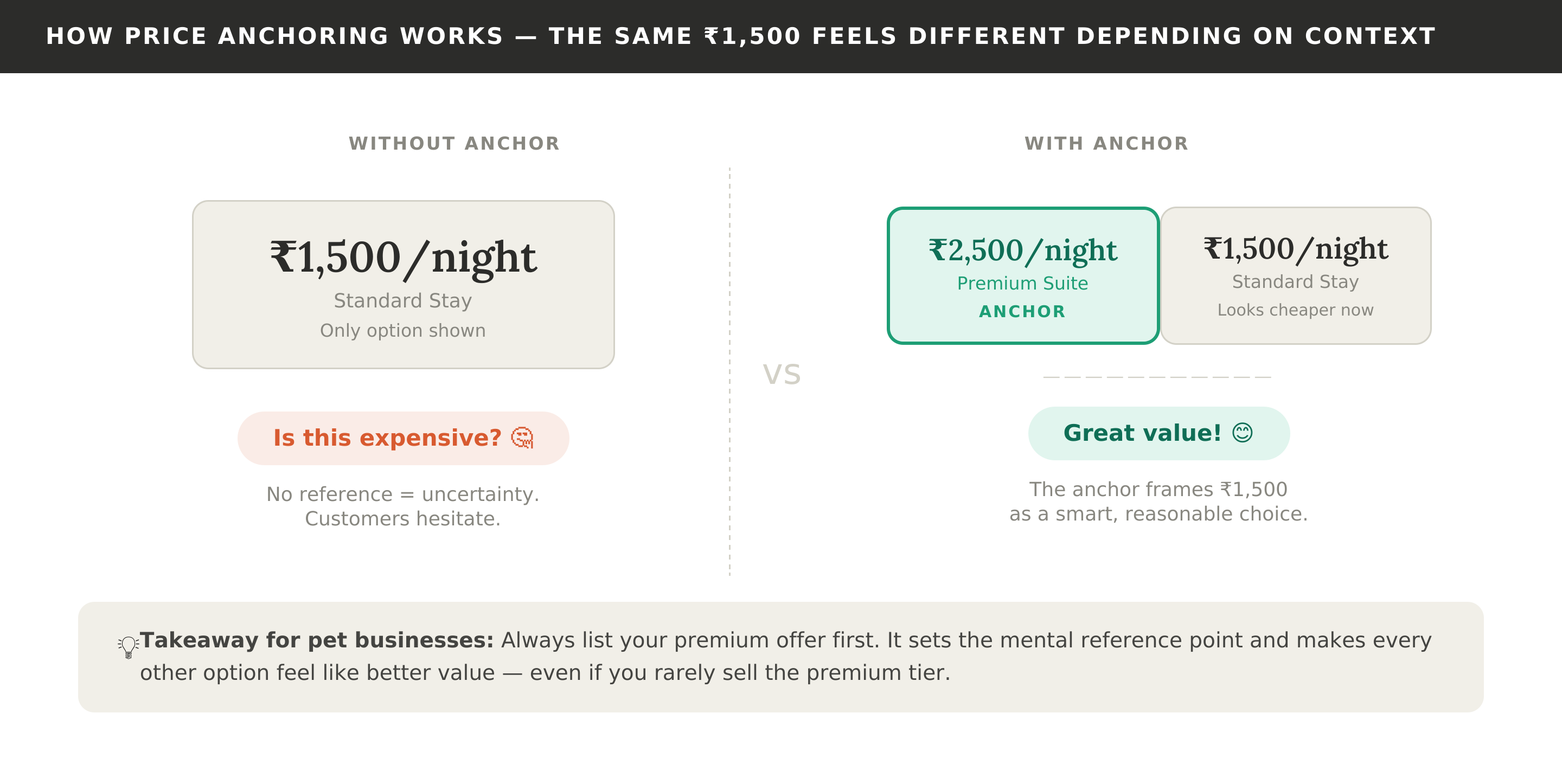
How It Works
The anchor works in both directions. A high-end offer elevates the perceived quality of everything below it. A low entry-level offer brings in price-sensitive customers at the door and gives you an opportunity to upsell during the booking process.
Pricing Tip
Before setting your lowest price, research what nearby competitors charge. An entry price that's significantly below the market average can signal lower quality rather than better value. Price low enough to compete, not so low that it raises questions.
Pet parents in India are increasingly comparing prices online before booking. How you frame your offers matters from the very first glance.
2. The Decoy Effect: Shape the Choice
Here's a counterintuitive insight from behavioral economics: sometimes the best way to sell an offer is to put a slightly worse option right next to it.
This is called the decoy effect, and it was famously illustrated by behavioral economist Dan Ariely. Here's how a similar setup looks applied to a pet boarding business
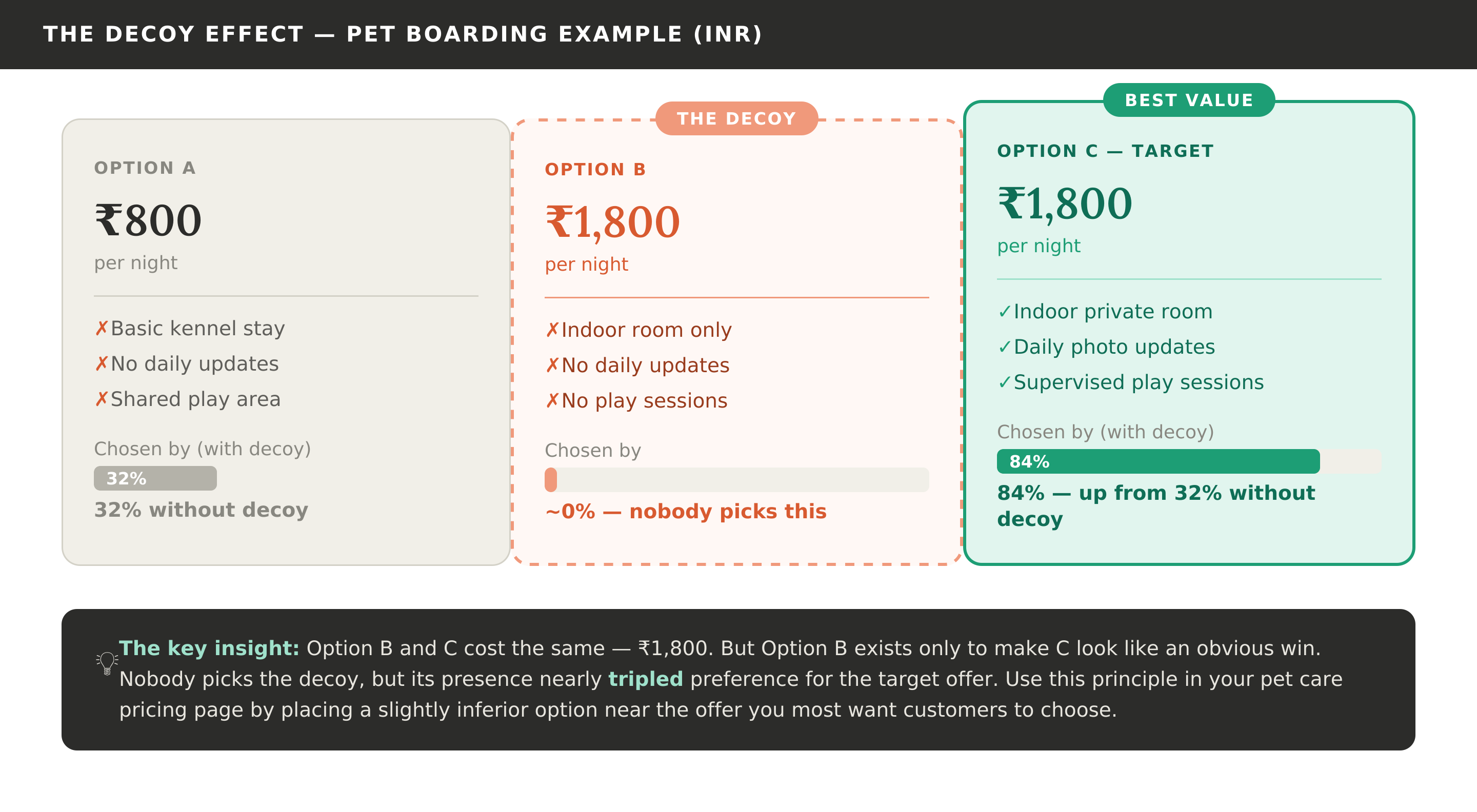
Option B is clearly a bad deal, same price as Option C, but far fewer benefits. Nobody picks it. But Ariely found that when Option B was present, 84% of people chose Option C. When Option B was removed, only 32% chose C.
Nobody wanted Option B. But its presence made Option C feel like an obvious win.
You don't need to be as blatant as this example. Placing a slightly inferior or awkwardly priced offer near your preferred option can make that option look dramatically more attractive, without changing the offer itself at all.
3. How Many Options Is Too Many?
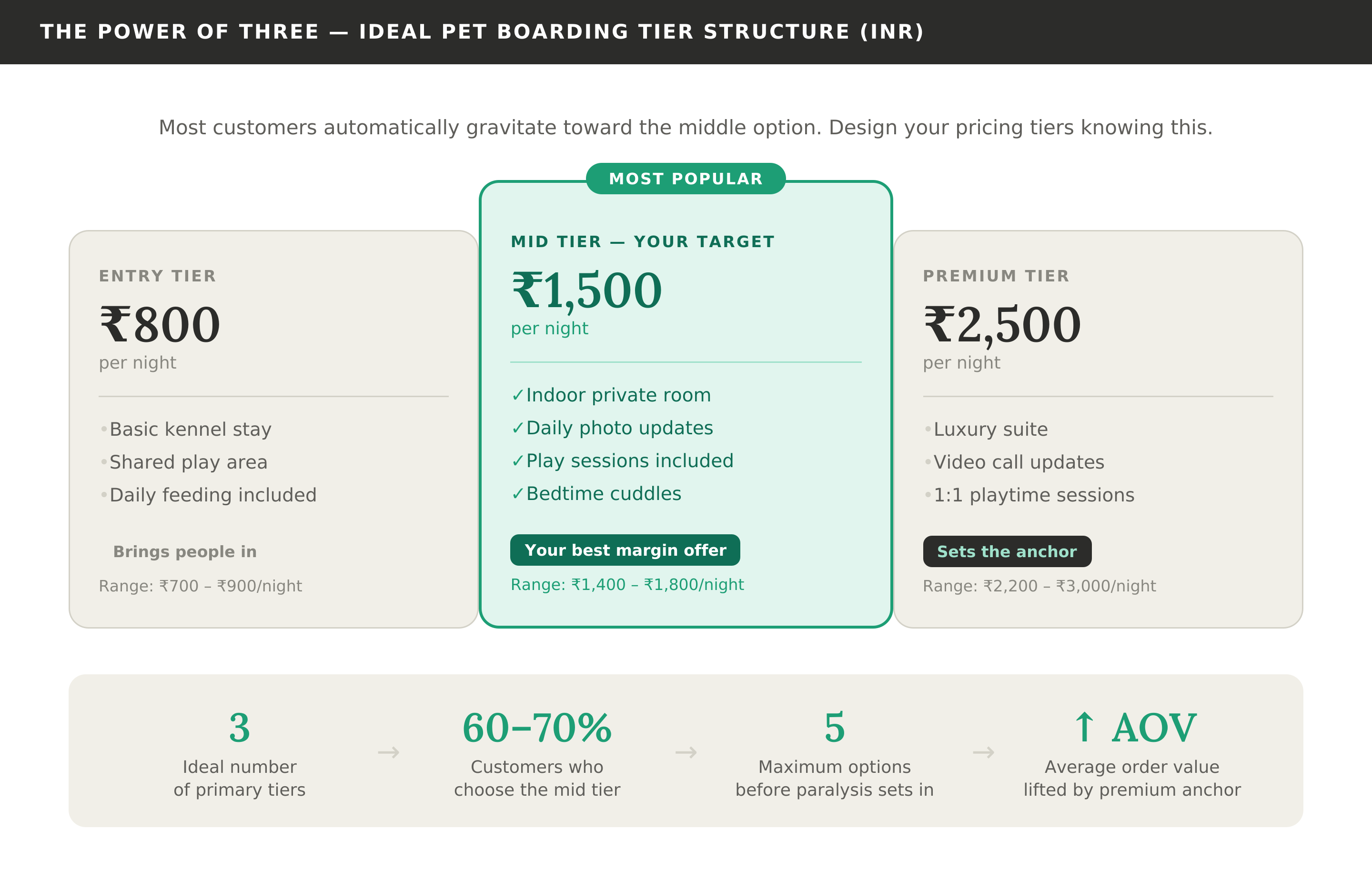
You understand anchoring now. So you know you need a high-end and a low-end option. But here's the thing most business owners overlook: the space between those two matters most.
Research consistently shows that when given three options, the majority of people choose the middle one. Not because it's the best value, but because it feels like the sensible choice, better than basic, without the splurge of premium.
"Your middle-tier offer is the one you actually want most customers to choose. Design for it."
When more options backfire
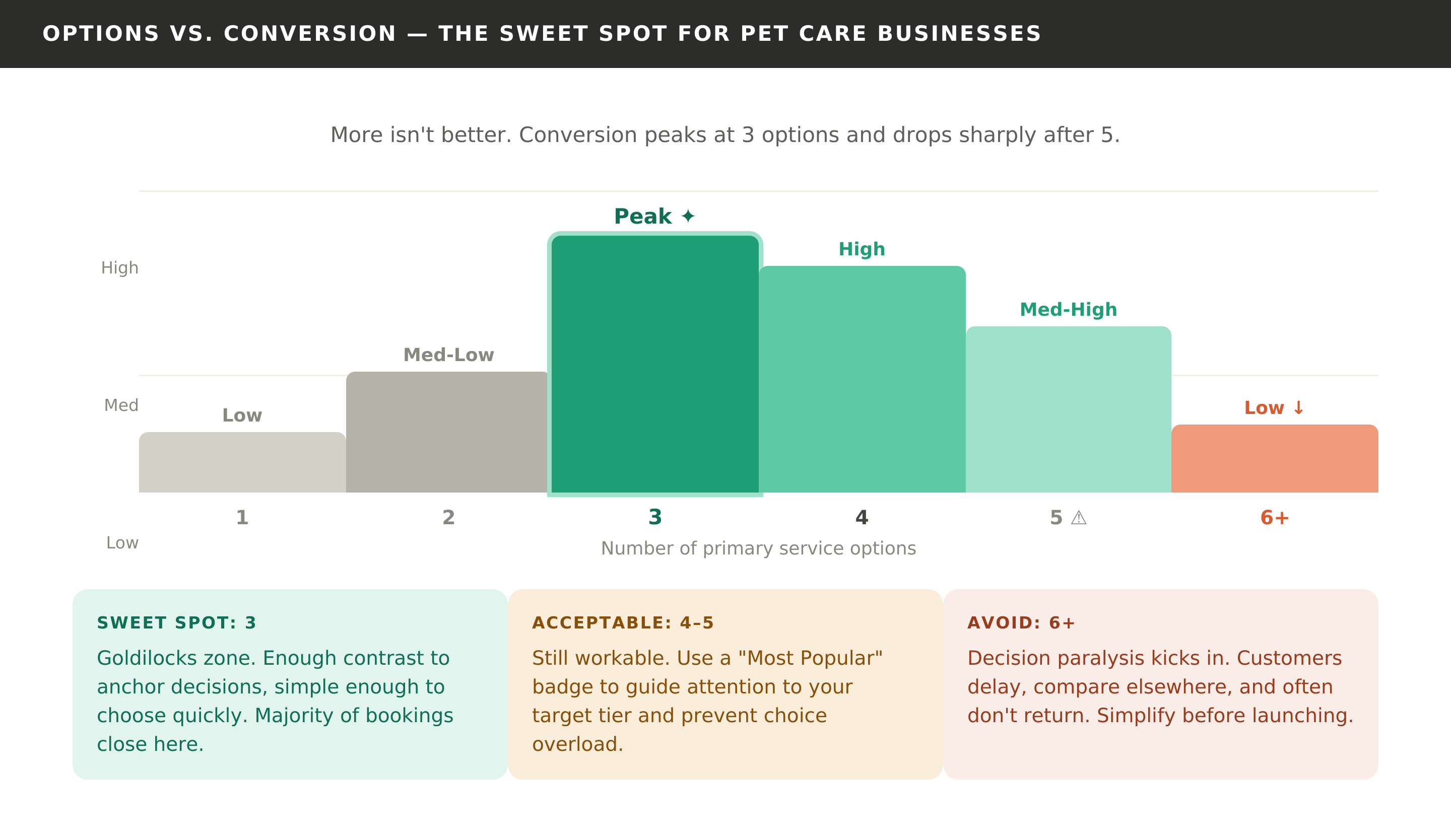
More choices feel like better service. But the research says otherwise. Too many options can cause decision paralysis, where customers feel overwhelmed and delay or abandon the booking entirely.
The Rule Of Five
Keep your primary offerings to five or fewer. More than five options makes it harder to choose, harder to compare, and harder to feel confident in the decision. The simpler and faster the first decision, the more likely it gets made.
4. Commitment and Completion Bias
There's one more psychological principle worth knowing, and it's the reason you want customers to make a selection early in the booking process.
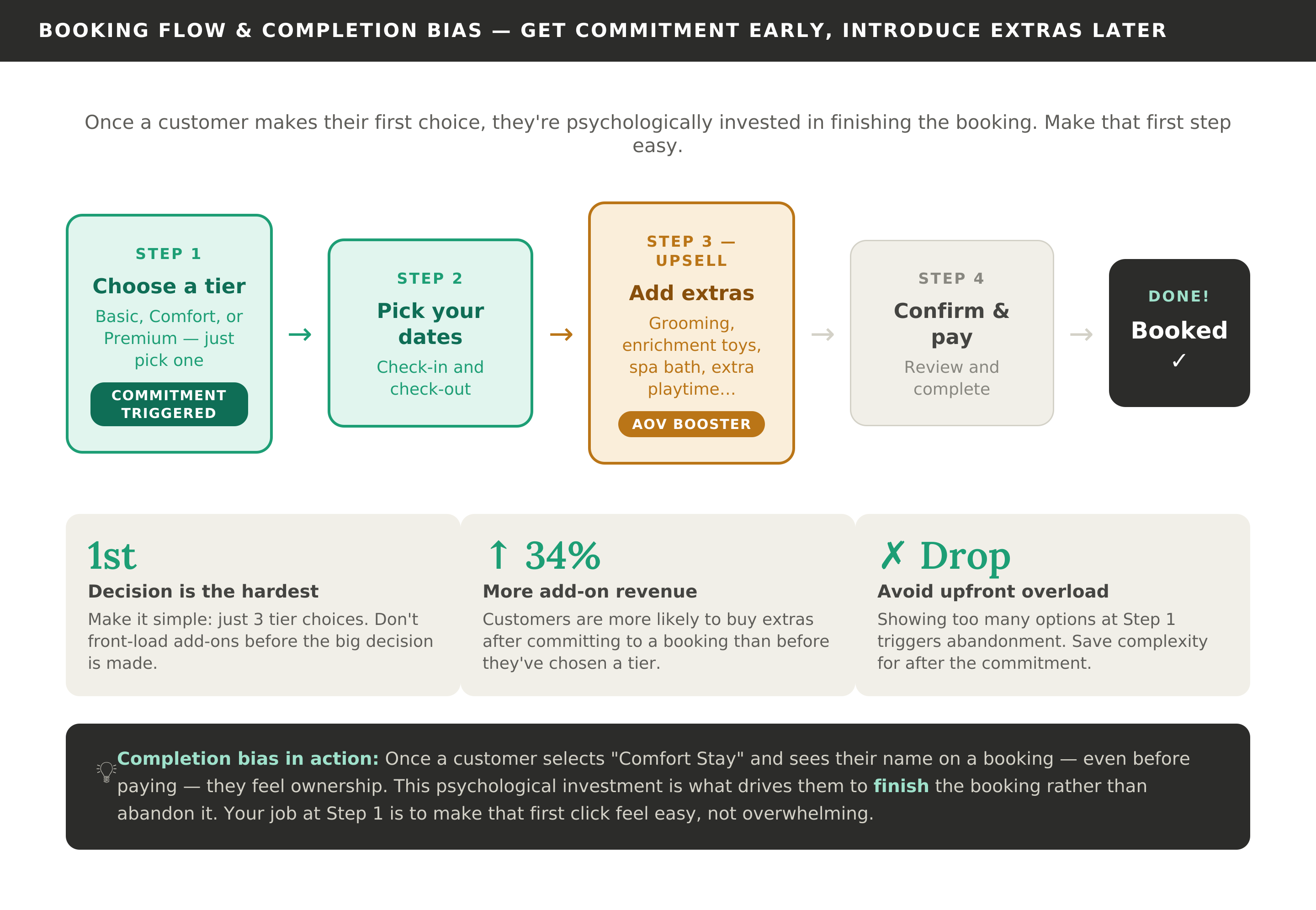
It's called completion bias: once we start something, we have a natural desire to finish it. Making an early decision, even a small one like selecting a boarding tier, creates a mental commitment that propels people toward completing the booking.
Practical Application
Keep your initial offer selection simple. Get the customer to commit to a tier first, then introduce add-ons, upgrades, and extras. Once they've made that first decision, they're already invested in completing the process.
This is why a clean, simple three-tier page outperforms a complex menu of services every time. The goal of your offers page isn't to show everything you do. It's to make that first click easy.
A frictionless booking experience, starting with a simple tier choice, keeps customers moving toward completion rather than dropping off.
Quick-Start Checklist
Ready to apply these principles? Here's what to audit in your current pricing setup:
- Do you have a clearly priced premium option? One that might feel slightly uncomfortable to list?
- Do you have a base-level entry offer to attract price-sensitive customers?
- Is your middle-tier offer the one you most want customers to choose?
- Are you using a "decoy" offer to make your target offer feel like a better deal?
- Do you have five or fewer primary options on your booking page?
- Does your booking flow ask for an early commitment before introducing add-ons?
Up Next: Designing Your Pet Care Offers in Practice
In Part 2 of this series, we'll walk through how to structure your pricing tiers, name your offers, and build add-ons that increase average booking value without overwhelming customers.
Conclusion
Pricing is rarely just about numbers. Before a customer reads your rates, their brain is already making judgments. Anchoring, decoys, and the power of three don't require you to overhaul your business. They just require you to be intentional about how your offers are presented. Small changes in structure can drive meaningfully bigger returns.