
 India
India UAE (Dubai)
 Australia
 Philippines
 Thailand









 Calendar Management
 Staff Management
 Inventory & Stock Mgt
 Web Mobile App
 Business Dashboard
 Billing & Invoicing
 Multi Branch management
 Integrations
Pet Business Software in India: Why Generic Tools Like Zoho and Vyapar Can't Keep Up

8 mins Read
Jul 01, 2026

Share
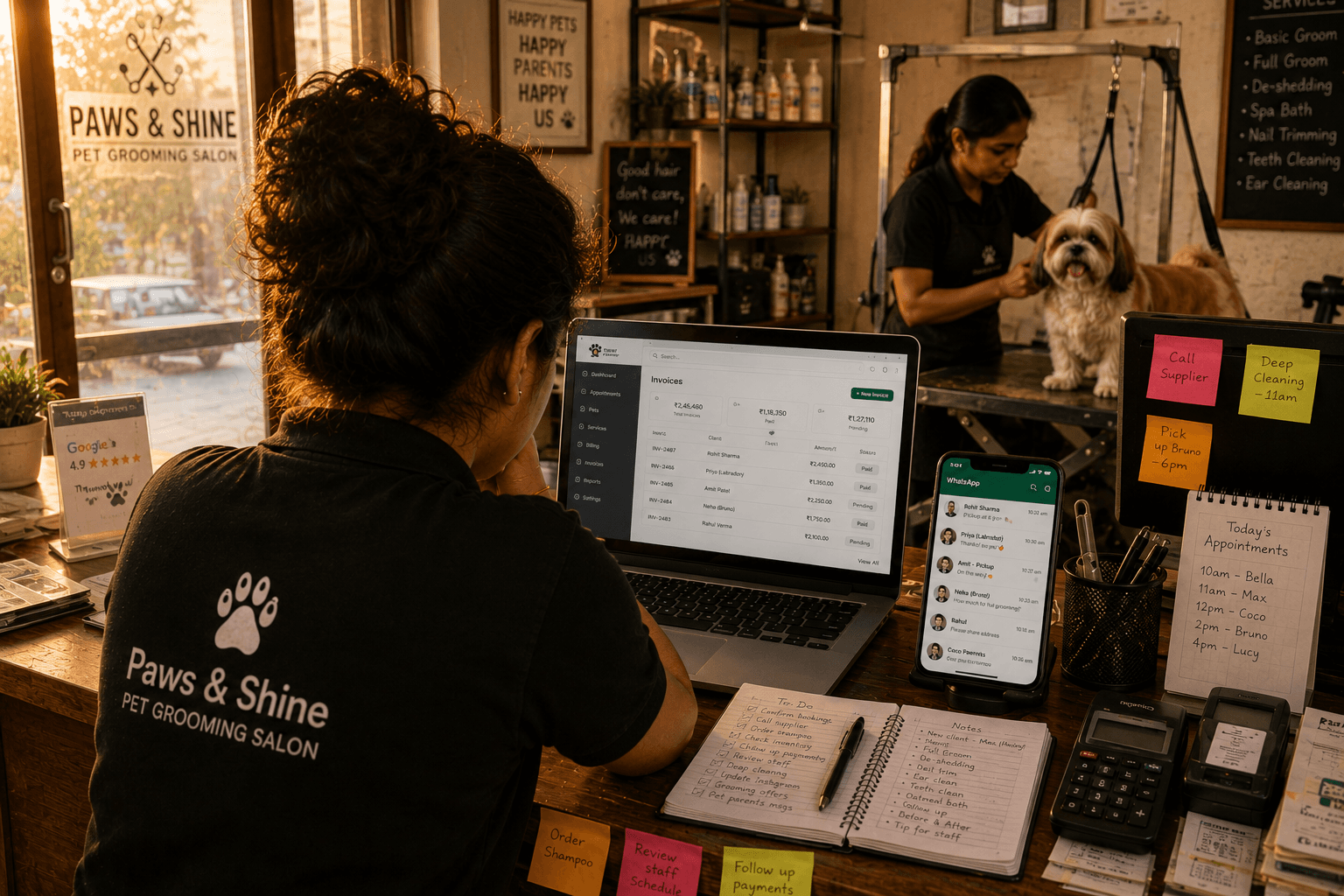
You've just opened your grooming salon. Or your boarding facility. Maybe you've been running it for a year now, and things are picking up. You decide it's time to "get organised", get a proper system in place. So you do what any sensible person would do: you Google it.
Zoho. Vyapar. MyBillBook. The names come up immediately. Your accountant probably uses one of them. Your friend who runs a clothing store swears by another. These are trusted, well-known tools. They look professional. They have apps. They have GST support. They have invoices.
So you sign up, spend a weekend setting things up, and by Monday morning you're ready to run your business properly.
Six months later, something feels off.
You're still maintaining a separate WhatsApp note for vaccination reminders. Your groomer has to ask every new customer what breed their dog is, how old, what coat type even though you've technically entered all that somewhere in the system. Your pricing is still mentally calculated because the tool doesn't know that a Labrador and a Pomeranian are priced differently not just by size, but by coat. A customer calls asking if their dog's rabies vaccination is due and you're fumbling through three different places to find the answer.
The software is working. But it's working for a generic business. Not yours.
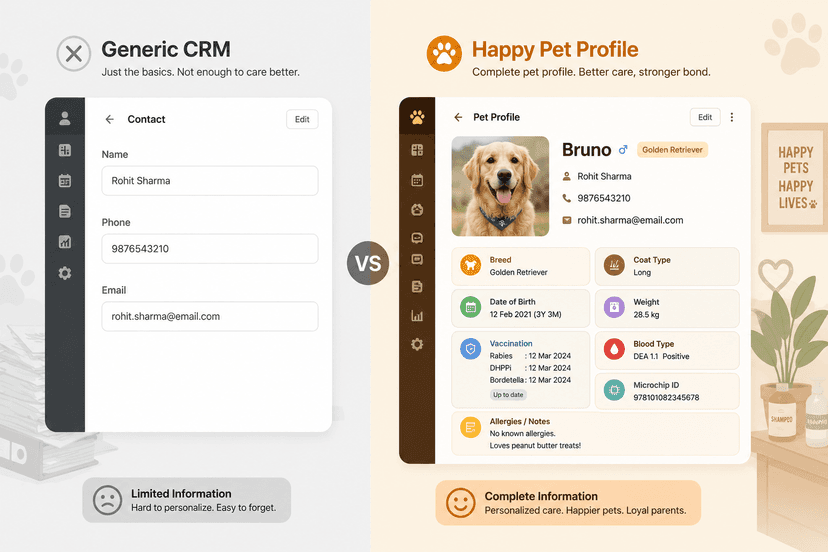
Generic Software vs. Software Built for Your Pet Business
There are two kinds of business software in the market today.
The first kind is built for every business. Zoho, Vyapar, and MyBillBook fall into this category. They're designed to work equally well for a clothing retailer, a hardware store, a travel agency, and a pet salon. The logic behind them is sound — billing, customer records, inventory, and reports are things every business needs. And to be fair, they deliver on that promise.
But "works for everyone" quietly means "built for no one in particular." When a tool has to serve a garment shop and a grooming salon with the same interface, it speaks in the language of SKUs, ledgers, and customer IDs. Not in the language of breeds, coat types, vaccination schedules, and grooming histories. That translation gap between what the software speaks and what your business actually needs is where the trouble starts.
The second kind of software is built only for one type of business. It already knows your world before you even log in for the first time the terminology, the workflows, the data that matters, the pricing logic, the compliance requirements. You don't have to teach it what a pet business looks like. It was designed around exactly that.
The difference between the two sounds minor until you're actually running a pet business. Then it becomes very, very practical.
The Hidden Cost of Setting Up the Wrong Software Pet Grooming Software
Here's something the horizontal software like Zoho, Vyapar MyBillBook. won't put in their marketing: setting them up properly for a specialised business is a project, not an onboarding.
When you sign up for Zoho for instance and want to manage a pet grooming business, you need to figure out:
- How to add pet breed as a custom field? (and then decide: which module? Contacts? A custom object?)
- How to add a second "profile" under one customer? (the pet, not the person)
- How to create pricing rules that vary by species, breed, coat variant, and size because a Poodle isn't priced the same as a Golden Retriever, even at the same "size"?
- How to attach vaccination records to a pet profile, not just a customer?
- How to set reminders based on service dates or vaccination dates, not just follow-up schedules?
- How to collect emergency contact details, medical history, allergies and make sure your staff can access them at the point of service, not after a search?
None of this is impossible in a horizontal tool. But none of it comes pre-built either. You're building it yourself or paying a Zoho partner to build it for you. That takes weeks. It takes decisions you don't have the experience to make yet. And most importantly, it takes you away from actually running your business.
And here's the uncomfortable part: even if you do build it all , the custom fields, the workflows, the reminder automations you've created a patchwork, not a system. Data points exist, but they don't talk to each other. A vaccination date is just a date. It doesn't trigger a reminder. The breed field is just a text entry. It doesn't influence pricing. The coat type you entered six months ago isn't connected to the service you're booking today.
You've collected data. But you haven't built intelligence.
The Real Cost of the Wrong Tool
Let's be honest about what using the wrong software actually costs a pet business.
Time: Every workaround costs time. Manually sending vaccination reminders costs time. Cross-referencing a pet's medical history across three tools costs time. Re-entering data that should have been captured once costs time. Over a year, this adds up to dozens — sometimes hundreds — of staff hours spent compensating for a tool that wasn't built for this business.
Data quality: Incomplete pet profiles, missing medical records, untracked service histories — these aren't just operational inconveniences. They're missed opportunities. The customer who never received a birthday reminder for their dog. The boarding guest whose allergies weren't flagged. The high-value grooming client who churned because nobody followed up after their last appointment.
Growth readiness: The business that collected complete, structured pet data from Day 1 is in a fundamentally different position at Year 2 than the one that used generic fields. One has a rich, actionable database. The other has a collection of partial records that can't be queried in any meaningful way.
Cost of switching: The longer you use a horizontal tool, the harder it is to switch. Your data, incomplete as it is, is in that system. Your staff knows it. Your workflows are built around it. The switching cost grows every month. Starting with the right tool isn't just convenient, it's financially rational.

A Word on Pricing
One objection that comes up fairly often: "But Zoho/Vyapar is cheaper."
This is worth examining carefully.
First, the headline price of these tool is almost never the real cost. Add the cost of the partner agency who configures your custom fields as how it should works for your pet business. Add the subscription for the separate reminder tool. Add the cost of the document signing software for service agreements. Add the ongoing cost of the staff hours spent maintaining the patchwork manually. The "cheap" option is rarely cheap when you add it all up.
Second, vertical platforms like Happy Pet Tech typically price on a growth model, you start with what you need and the pricing scales as your business does. This is how it should work: the tool pays for itself by eliminating the inefficiencies it replaces.
Third, and most fundamentally: the question isn't "what does the software cost?" It's "what does the right data, captured correctly from Day 1, eventually become worth to my business?" The answer, for a pet business with ambitions to grow, retain loyal customers, and making intelligent decisions is everything.
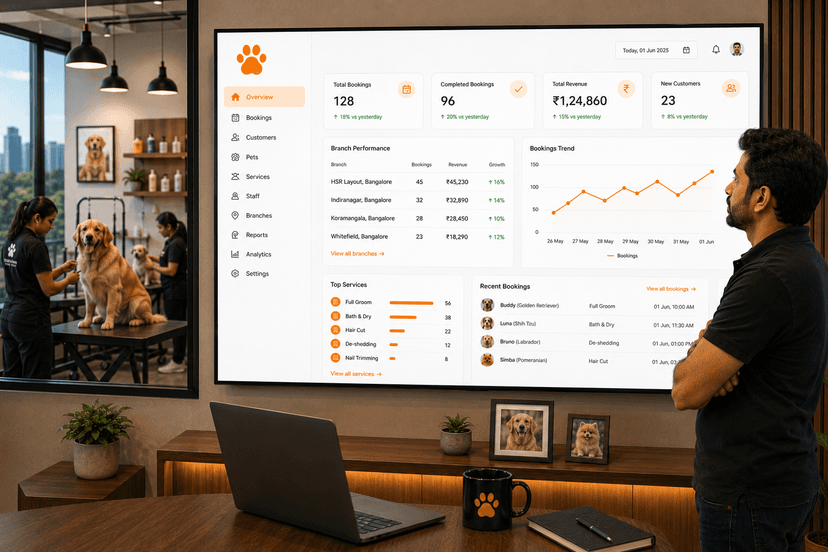
What Day 1 Should Actually Look Like
A first-time pet business owner in India, opening a grooming salon in Bengaluru or Mumbai, typically thinks they need three things on Day 1: a way to take bookings, a way to generate invoices, and a way to keep track of customers.
They're not wrong. But what they actually need, what they'll realise they need by Month 6 — is something richer. They need a system that, by the time it has 200 customers in it, can tell them: which pets are due for a vaccination reminder this week, which customers haven't visited in 90 days, which breed-service combinations are most profitable, which new customers came in through referrals versus walk-ins, and which pets have medical notes that the groomer should read before they start work.
None of this is complicated. But it all depends on capturing the right data, in the right structure, from the very beginning.
The grooming salon owner who starts with a random generic tool and adds pet fields manually will have a database in 6 months. The one who starts with a platform built for pet businesses will have intelligence — a system that already understands what they're trying to do, and has been quietly building the foundation for every insight and automation they'll eventually need.
That's the real difference. Not features. Not price. Not even the interface.
It's whether the software you chose on Day 1 was designed to understand your world — or to accommodate it.
Conclusion
Happy Pet Tech is pet business software built exclusively for grooming salons, boarding facilities, veterinary clinics, and pet retail businesses across India, the UAE, Philippines and Thailand, it is designed for the pet industry, not adapted from a generic CRM.

How to Use WhatsApp to Grow Your Pet Business? (Automation + Templates)
Aug 20, 2026
GST Invoicing for Pet Business: Things You Should Know Before Tax Filing in India (Beginner's Guide)
Aug 08, 2026
Best Pet Grooming Software in 2026: Complete Comparison Guide
Aug 06, 2026

Best Pet Boarding Software in 2026: Complete Comparison Guide
Jul 31, 2026