India
India UAE (Dubai)
 Australia
 Philippines
 Thailand









 Calendar Management
 Staff Management
 Inventory & Stock Mgt
 Web Mobile App
 Business Dashboard
 Billing & Invoicing
 Multi Branch management
 Integrations
GST Invoicing for Pet Business: Things You Should Know Before Tax Filing in India (Beginner's Guide)

12 mins Read
Aug 08, 2026

Share
This article is written from a builder's perspective, not a tax professional's. It's meant to help you understand the basics and ask the right questions, always confirm your specific setup with a chartered accountant (CA).
If you run a pet business in India a grooming salon, a boarding facility, a retail store, a vet clinic, or some combination of all four chances are your invoicing looks a little different from a typical shop. You might be billing a grooming session and a bottle of shampoo on the same ticket. You might take an advance for a boarding stay next month. You might have a vet visit where part of the bill is exempt and part isn't.
None of the standard GST guides are written for this. They're written for a business that sells one type of thing. This one isn't.
1. Which Kind of Pet Business Are You?
Before anything else, it helps to know which bucket (or buckets) you fall into, because GST treats them differently:
- Grooming, boarding, daycare, training — these are services, taxed under an SAC (Services Accounting Code)
- Retail (food, toys, accessories, medical supplies) — these are goods, taxed under an HSN (Harmonized System of Nomenclature) code
- Veterinary clinics — a mix: exempt consultation, taxable medicine, sometimes taxable grooming or spa add-ons, all in the same visit
- Multi-service businesses — most pet businesses in India today are actually this. A grooming salon that also sells shampoo. A boarding facility with a small retail corner. A vet clinic that grooms too.
If you're in that last group, don't worry this guide is written with you specifically in mind. A single invoice for you might need to carry two or three different tax treatments, and that's completely normal once you know how to structure it.
2. Should Your Pet Business Even Be Registered?
GST registration is mandatory once your annual revenue crosses ₹20 lakh for services (grooming, boarding, training) or ₹40 lakh for goods (retail). Below that, it's optional but "optional" doesn't mean "not worth it."
Here's the short version of why: if you're not registered, you can't charge GST to customers, but you also can't claim back the GST you pay on your own purchases; grooming supplies, pet food inventory, equipment, software, rent. That GST just becomes a cost you silently absorb. Registered businesses can offset what they've paid against what they've collected, which is called Input Tax Credit (ITC), and it often works out cheaper than staying unregistered, especially once you're spending meaningfully on supplies or equipment.
There are also a few situations where registration is mandatory regardless of revenue selling online (your own website, Amazon, Flipkart), operating across states, or running a multi-branch or franchise setup.
This decision deserves more space than a beginner's guide to invoicing can give it. We covered it in full detail thresholds, the ITC math, when voluntary registration pays off — in a separate guide: How GST Works for Pet Businesses in India: Should You Register for GST?
For the rest of this article, we'll assume you're registered (or about to be) and focus on what happens next: raising invoices correctly and staying filing-ready.
3. Raising the Invoice: The Multi-Line Problem
This is where most pet businesses actually get tripped up, because your invoice usually isn't just one thing.
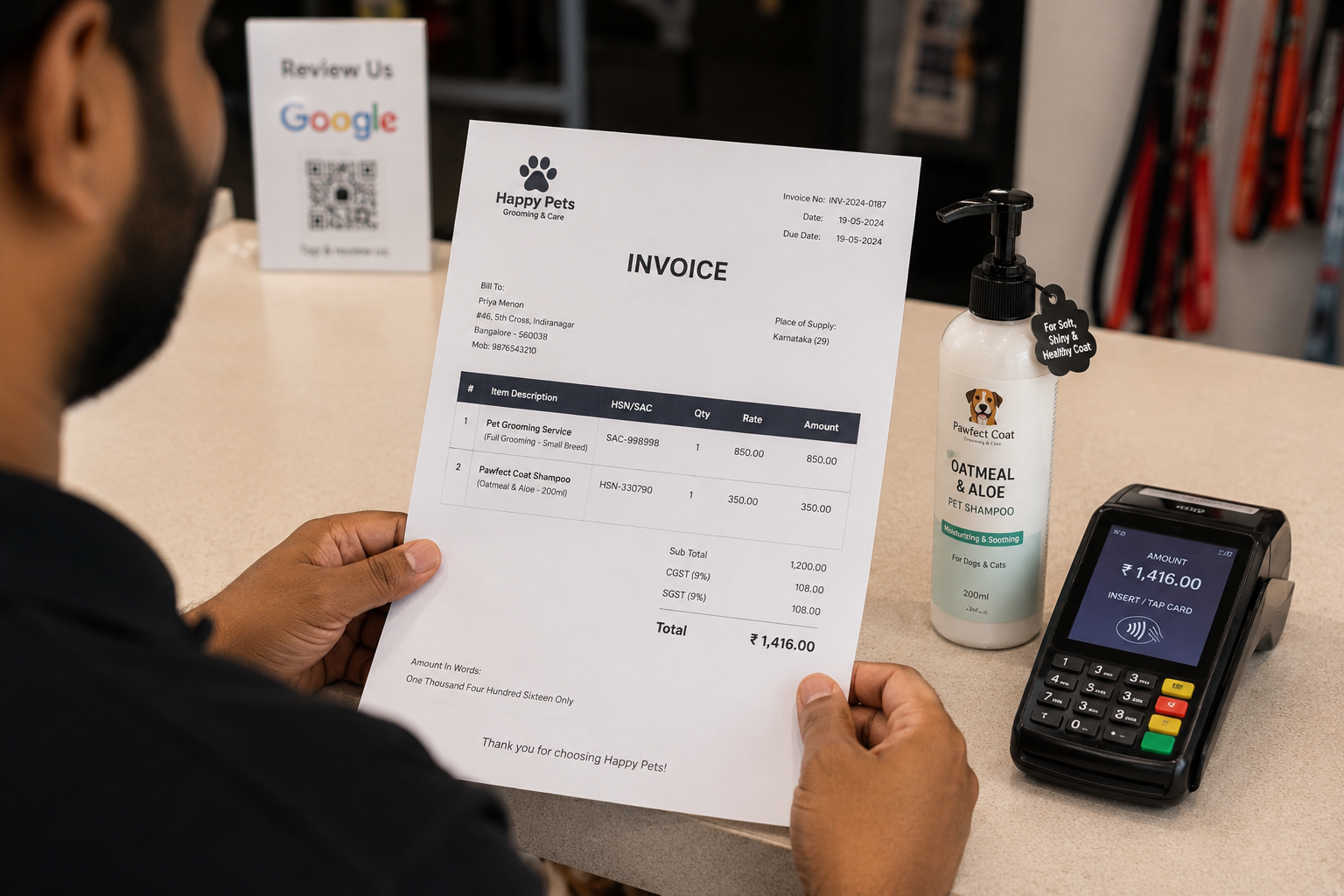
Say a customer brings their dog in for a grooming session and also buys a bottle of shampoo. That's two different tax treatments on one bill:
| Line item | Type | Code | Typical rate |
|---|---|---|---|
| Grooming service | Service | SAC | 18% |
| Shampoo (retail) | Goods | HSN | 18% (varies by product) |
They may happen to share a rate here, but that's a coincidence, not a rule, pet food for instance, can fall under 5% or 18% depending on the type, and toys can be 5%, 12%, or 18%. The point isn't to memorize every rate (they change, so don't rely on this article for that, check the current CBIC rate schedule or your CA before filing), it's to get into the habit of treating each line item on its own merits, not applying one blanket rate to the whole bill.
One thing to watch for — composite vs. mixed supply:
- If the flea bath is a natural part of the grooming service you sold (i.e., you didn't sell it separately), the whole thing is taxed at the grooming service rate. This is a composite supply.
- If you bundled unrelated, independently-sellable items together say, a "starter kit" of a leash, a toy, and a treat pack, priced as one, the whole bundle takes the highest rate among the items inside it. This is a mixed supply.
Getting this backwards either overcharges a customer on a natural bundle, or undercharges the department on a mixed one. Neither is a great place to be.
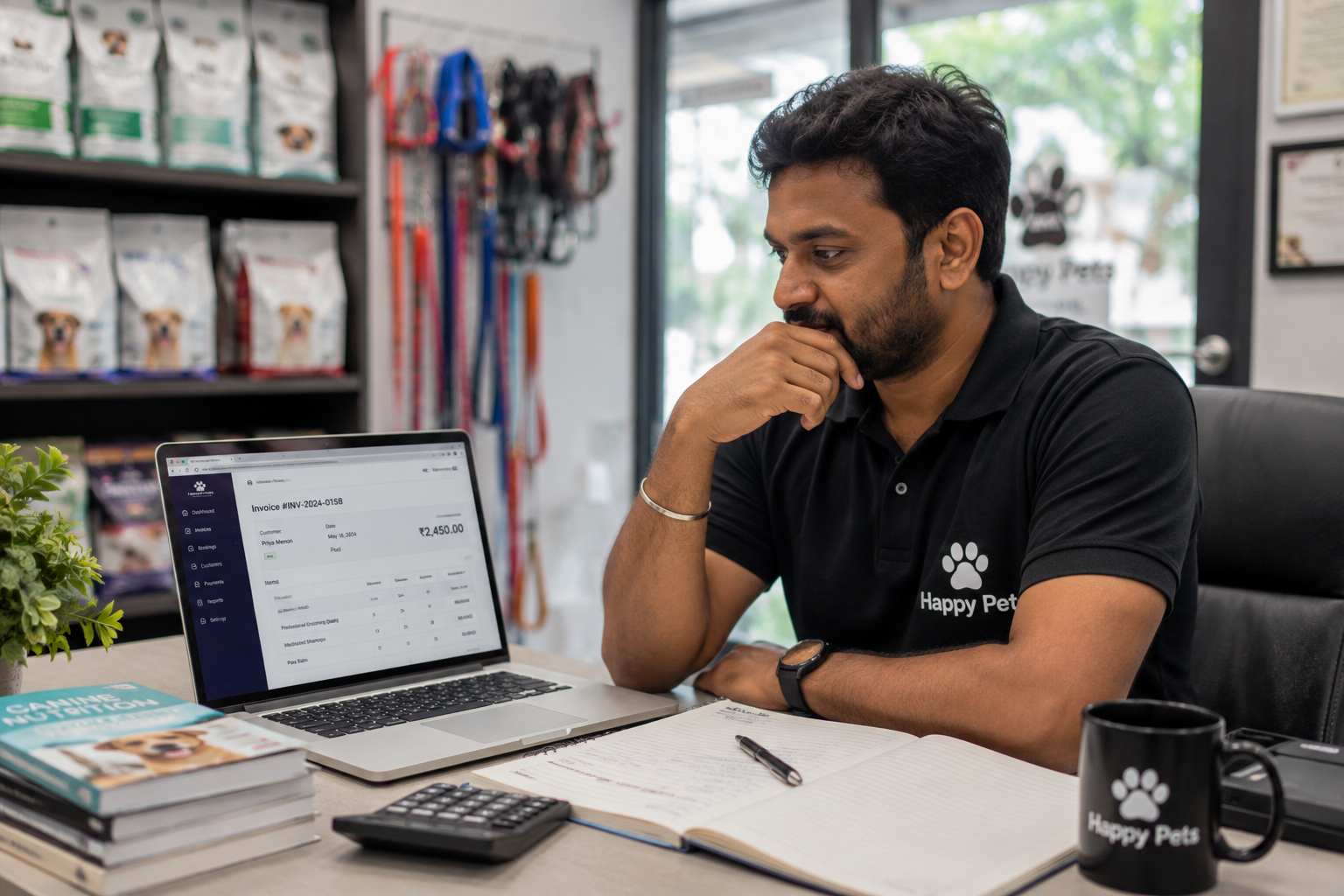
Practical takeaway: if your invoicing software can't split a bill into multiple line items with different tax rates, you will eventually make this mistake — not because you don't understand GST, but because your tooling doesn't support doing it correctly.

4. Vet Clinics: The Trickiest Case
If you run a clinic, you likely deal with all three tax situations at once, sometimes in a single visit:
- Consultation — veterinary healthcare services are generally GST-exempt
- Medicine dispensed — taxable, separately from the consultation
- Grooming or spa add-ons — taxable at the standard service rate
The exemption on veterinary services is a genuinely useful thing to know, but exemptions are also exactly the kind of detail that shifts with policy updates — don't take this article's word for where the exact line sits today. A CA will tell you precisely what's exempt and what isn't for your clinic's specific services.
The invoicing implication is simple even if the tax rules aren't: don't lump the consultation and the medicine into one line. Split them, so your books and your GST filing reflect what was actually exempt and what wasn't. Happy Pet Tech's clinic management software is built to keep exempt and taxable line items separate by default, so this isn't something you have to remember to do manually every visit.
5. Getting the Basics Right: Numbering, Records, Place of Supply
A few fundamentals apply no matter which part of the pet industry you're in:
- Invoice numbering must be consecutive, with no gaps, and reset at the start of each financial year (1 April). If you cancel an invoice, you don't reuse that number, you just leave the gap and note the cancellation.
- Record retention — hang on to your invoices for at least 6 years from the due date of your annual return. This isn't optional bookkeeping hygiene; it's a compliance requirement.
- Place of supply matters more than people expect, especially if you have multiple branches or ship products across states. Get this wrong and the tax may effectively be recorded for the wrong state which tends to surface as a mismatch much later, not immediately.
- Transparent Invoicing Most pet businesses sell to individual customers (pet parents), not other businesses which puts you in B2C territory for GST purposes. Practically, this means you're not chasing a GSTIN from every customer, but you still need to invoice properly and be able to report your sales by state and tax rate when you file.
6. Advance Payments, Partial Payments, and Unpaid Bills
This is the part that confuses almost every pet business owner at some point, because it feels like it should be simple you got paid, or you didn't but GST doesn't quite see it that way.
Advances received before the service. If a customer pays a deposit for a boarding stay next month, or pre-pays for a grooming package, that advance can trigger a GST liability at the time you receive it not later, when the service is actually delivered. This trips people up because the money is often not fully "earned" yet, but the tax event may already have happened.
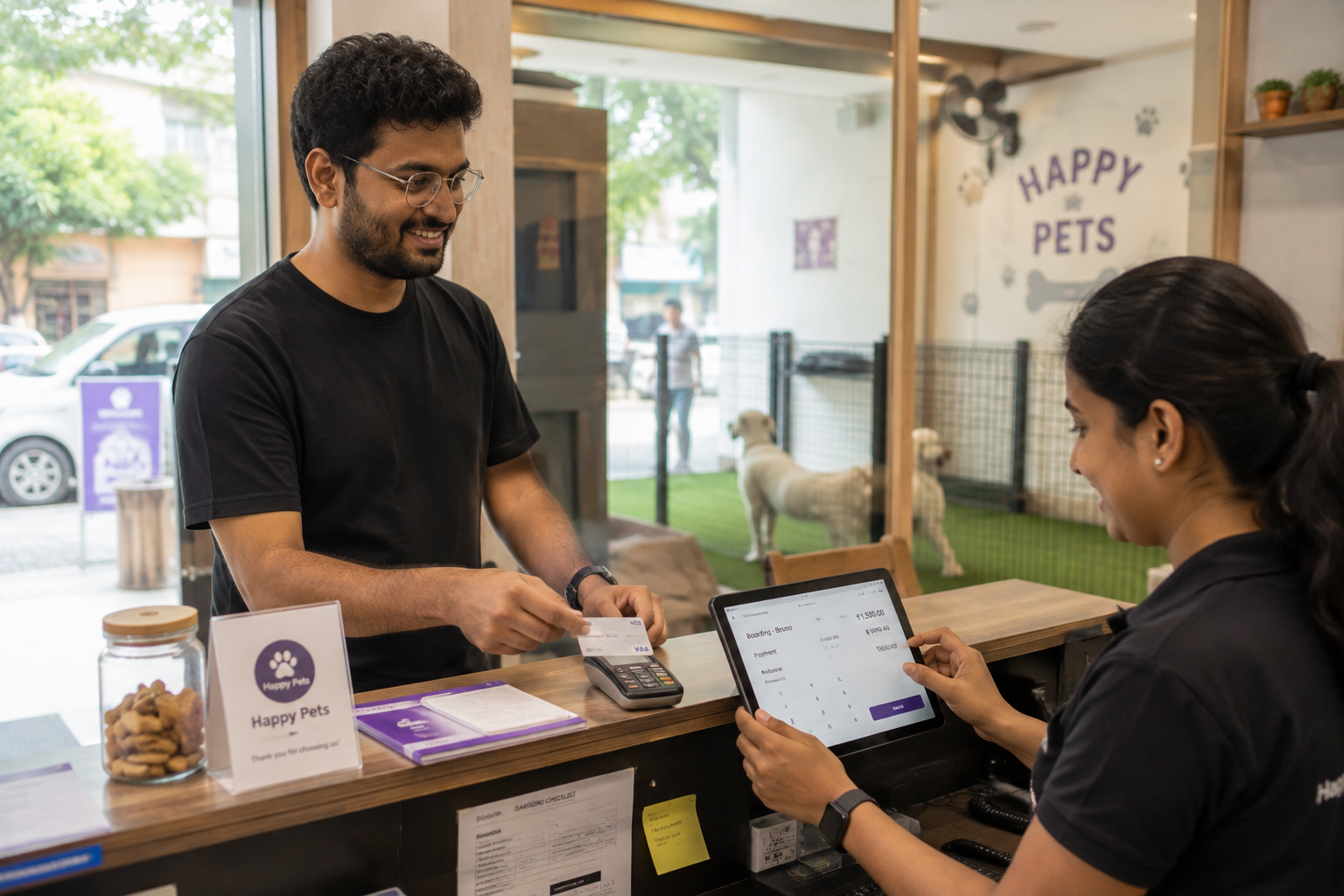
Partial payment at pickup or checkout. Suppose a boarding bill comes to ₹5,000 but the customer only pays ₹3,000 at pickup, promising to settle the rest later. You still invoice the full ₹5,000 the invoice reflects what was owed, not what was collected. GST liability is generally tied to the invoice, not your bank balance. This is the single most important idea in this section: invoicing and getting paid are two separate events, and GST usually cares about the first one.
When a customer doesn't pay at all, or disputes the bill. Here's where it gets genuinely tricky, you've already invoiced (and likely reported) the GST on that amount, but the money never came in, or you had to refund it. This is exactly what a credit note is for. It lets you formally reduce your reported sales and tax liability to reflect the amount you're writing off or refunding, so you're not stuck having "paid tax on income you never received."
A couple of things worth knowing about credit notes:
- They have to reference the original invoice you can't issue one in isolation.
- There's a time limit on when you can use a credit note to reduce your tax liability (broadly tied to the end of the following financial year or your annual return filing, whichever comes first) so this isn't something to leave sitting for a year and revisit "eventually."
- If you're refunding GST back to the customer as part of the credit note, you generally need to actually complete that refund for the tax adjustment to hold up.
It's worth building a simple habit: track unpaid/partially-paid invoices separately, and don't let credit notes pile up unissued.
7. The Filing Rhythm
Once you're registered and invoicing correctly, filing follows a fairly predictable rhythm:
- GSTR-1 — where you report your outward supplies (what you sold, GST collected). Filed monthly or quarterly depending on your turnover.
- GSTR-3B — a summary return where you declare total sales, purchases, ITC claimed, and pay the net GST owed. Generally monthly.
- Annual Return — a once-a-year reconciliation of everything filed across the year against your books.
Smaller businesses often qualify for the QRMP scheme (quarterly filing, monthly payment), which can meaningfully cut down the frequency of formal filings while still keeping payments current.
The rhythm that actually matters day-to-day: your invoices should roll up cleanly into GSTR-1, and any mismatch between what you've invoiced and what you eventually file is usually where notices and headaches come from. Reconciling monthly, rather than scrambling once a year, is the difference between GST being routine and GST being stressful.
8. Common Mistakes Pet Businesses Make
A quick list of the ones that come up again and again:
- Charging one flat rate across a mixed bundle, instead of splitting by item
- Lumping a vet consultation and dispensed medicine into one line, losing the exemption on the service portion
- Skipping HSN codes on retail items, especially in smaller stores that started out informally
- Reusing a cancelled invoice number instead of leaving the gap
- Not tracking advances properly, and getting caught off guard by the GST liability timing
- Letting unpaid invoices sit without issuing credit notes, and effectively overpaying tax on money never received
- Registering too late, after growth has already outpaced the threshold, and scrambling to backfill compliance
Most of these aren't complicated once you know they exist, they're just easy to miss when you're focused on running the actual business.
Before You File
GST rates, thresholds, and exemptions get revised periodically, and this article reflects a general understanding of how things work rather than the exact current figures — those are worth double-checking against the CBIC portal or your CA before you rely on them for an actual filing.
This guide is meant to help you ask better questions and structure your invoicing sensibly — not to replace professional advice. Every pet business has its own mix of services, products, and operating style, and a CA who can look at your specific setup will always be a better source of certainty than a blog post. If you're past the point of "just curious" and into "actually need to get this right," that conversation is worth having.
Conclusion
Happy Pet Tech turns GST from a scramble into a system, every invoice is split correctly by service and product line automatically, so your GSTR-1 and GSTR-3B are sorted.