
 India
India UAE (Dubai)
 Australia
 Philippines
 Thailand
 Malaysia









 Calendar Management
 Staff Management
 Inventory & Stock Mgt
 Web Mobile App
 Business Dashboard
 Billing & Invoicing
 Multi Branch management
 Integrations
How GST Works for Pet Businesses in India: Should You Register for GST? (Complete Guide 2026)

9 mins Read
Mar 03, 2026

Share

India’s pet industry is growing faster than ever. What started as small home-run grooming services and local pet stores has now evolved into organized businesses offering grooming, boarding, training, veterinary care, and online store.
But as your pet business grows year by year, one question creates the most confusion:
“Do I need GST registration, and should I register even if it’s not mandatory?”
I spoke to 8 different pet businesses, ranging from one offering only pet grooming services at home, to a few providing grooming services with more than one branch, and a few that cover grooming, boarding, and veterinary services, including selling pet food and pharmaceutical products as well, generating revenue between ₹5 lakhs and ₹4 crore per fiscal year.
Some of these pet business owners either delay registration unnecessarily or assume GST only matters for large businesses.
In reality, GST is not just a compliance requirement; it directly affects profitability, pricing, and business growth. However, those who do not require GST and stay under the threshold bracket feel it is an unnecessary burden, especially when trying to keep expenses as low as possible.
This guide explains how GST works for pet businesses in India and helps you decide whether GST registration is the right move for your business, irrespective of whether your business falls under the threshold.
Types of Pet Businesses Covered Under GST

GST rules apply differently depending on your business model, but most pet businesses fall into one of these categories:
- Pet grooming salons
- Pet boarding and daycare centers
- Veterinary clinics (Tax Exempt but still need to file GST)
- Pet training and behavior services
- Pet product retail stores (offline)
- Breeders
- Pet spas and wellness centers
Even small home-based businesses may fall under GST rules once revenue grows or services expand across states.
When people talk about filing GST, many find it too complex. But it’s not rocket science. To put it simply, if you are running a proper business irrespective of the size of your revenue, you should be maintaining regular accounts to understand how your business is performing, where losses are happening, and where there are opportunities to grow your pet business.
Consider GST filing as one addition to your existing accounting process. You are simply submitting tax details to the government. The best part is that you are directly contributing to the economy of your country.
How GST Works (Simple Explanation)?
GST (Goods and Services Tax) is an indirect tax collected by businesses on behalf of the government.
Here’s the basic idea:
- You charge GST to customers.
- You pay GST when purchasing business supplies such as shampoos, tissue papers, and grooming kits for grooming services, as well as retail products.
- You subtract the GST already paid to the vendors from whom you sourced supplies and pay the balance GST collected from your customers (ideally pet parents).
- Only the remaining amount is paid to the government. This process is completed through GST filing (monthly or quarterly).
This system is called Input Tax Credit (ITC), and it is the most important concept to understand.
In simple terms:
GST ensures tax is paid only on the value you add to a product or service.
Example:If you run a pet grooming salon and charge ₹1,000 + 18% GST (₹180) from a customer, the total bill becomes ₹1,180.You already paid ₹50 as GST on shampoos and grooming supplies purchased from vendors.So instead of paying the full ₹180 to the government, you subtract ₹50 and pay only ₹130.
This ₹50 adjustment is called Input Tax Credit (ITC).
When Is GST Registration Mandatory?
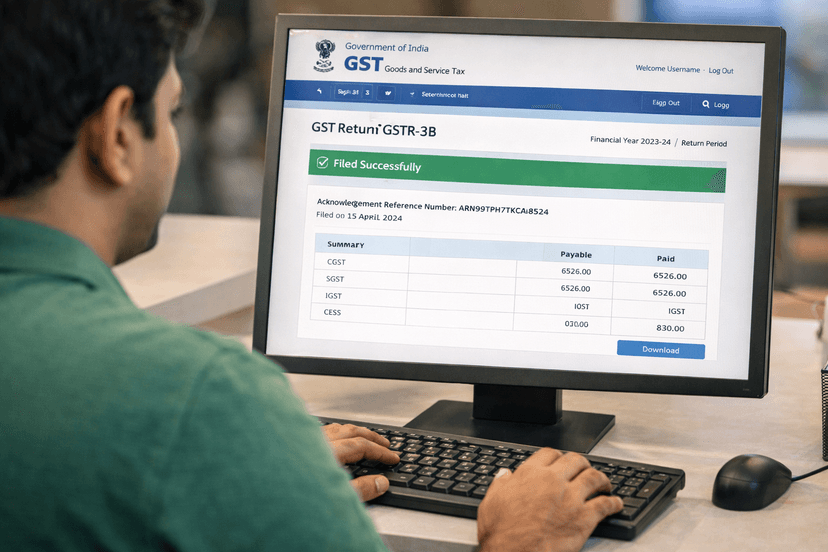
Turnover Threshold
GST registration becomes mandatory when annual revenue exceeds:
Service businesses (grooming, boarding, training) - ₹20 lakh/year
Goods businesses (pet product retail) - ₹40 lakh/year
If your revenue is below these limits, GST registration is optional, not compulsory.
Cases Where GST Is Mandatory Even Below the Threshold
Many pet businesses miss this rule.
You must register if you:
- Sell products online (Amazon, Flipkart, your own website, or a D2C brand)
- Provide inter-state services
- Operate via marketplaces or aggregators
- Run franchise or multi-location operations
In these situations, GST registration is required regardless of revenue.
Should You Register for GST If You’re Below the Limit?
This is where most business owners get confused.
Let’s compare both choices.
Option 1: Stay Unregistered
If your revenue is below ₹20 lakh (services) and ₹40 lakh/year (Goods) you may choose not to register.
Benefits
- No GST filings
- Minimal compliance work
- Simpler accounting
Limitations
- Cannot charge GST to customers
- Cannot claim Input Tax Credit (ITC)
This means the GST you pay on purchases becomes a business expense which impacts your margin
For example, if you purchase grooming supplies and pay ₹18,000 as GST, subscribe to business software and pay ₹3,600 as GST, and buy equipment with ₹20,000 GST included, you cannot claim any of this GST as Input Tax Credit if you are not registered under GST. This means the entire GST paid becomes part of your business cost.
If you are a pet business primarily selling retail products, all the GST you pay to your vendors becomes your cost. You will then need to add your profit margin on top of this total cost to maintain profitability. Since you cannot charge GST separately from customers, you still end up indirectly bearing GST on everything you purchase.
Option 2: Voluntary GST Registration
You can register for GST even if your revenue is below the mandatory threshold.
Benefits
- Charge GST legally
- Claim Input Tax Credit (GST paid on purchases from vendors and supplies)
- Reduce effective operating costs
- Build professional credibility
- Enable easier B2B partnerships
Trade-off
- Monthly or quarterly compliance and return filing are required
For growing pet businesses, voluntary registration can be financially beneficial. Maintaining consistent GST filings even before crossing the threshold demonstrates professionalism and financial discipline. This strengthens credibility and may help when seeking loans, government support, or investment in the long run.
GST Rates Classification to Pet Businesses Offerings per Category
Services
Pet grooming 18%
Boarding & daycare 18%
Training services 18%
Goods
Pet food - 5% or 18% (depends on type)
Accessories - 18%
Toys - 5% or 12% or 18% (depends on type)
Pet shampoos & care products - 18%
Pet Medical Supplies - GST Exempt or 5% or 18% (depends on type)
GST classification depends on HSN codes used during invoicing.
Special Case: Veterinary Clinics
Veterinary businesses often operate under mixed GST treatment.
- Veterinary healthcare services are GST Exempt
- Medicines sold separately are GST Applicable
- Grooming or spa services are Taxable (18%)
This means clinics may handle both taxable and exempt income simultaneously.
Understanding Input Tax Credit (ITC) and Output Tax: The Hidden Advantage
Registered pet businesses can claim GST paid on:
- Grooming consumables
- Pet food inventory
- Equipment and cages
- Commercial rent
- Marketing services
- Software subscriptions
- Packaging materials
Simple formula:
GST collected – GST paid = Tax payable, here GST paid is Input Tax Credit (ITC) and GST you received from your customer is Output Tax
Example:
- GST collected from customers: ₹50,000
- GST paid on expenses: ₹30,000
You pay only ₹20,000 to the government.
Overview of GST Compliance Requirements
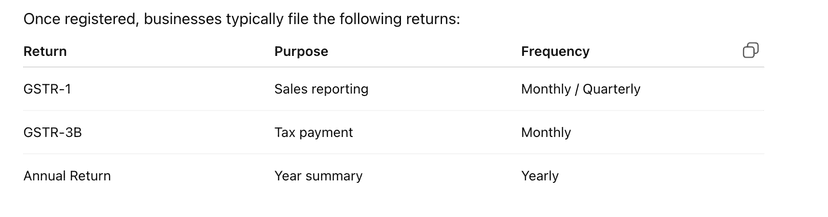
Late filing may attract penalties and interest.
Brief Overview of These Return Types
These are the primary GST returns that most pet businesses need to understand and comply with:
GSTR-1 – This return contains details of all outward supplies (sales). You report invoices issued to customers, including GST collected. It can be filed monthly or quarterly, depending on your turnover.
GSTR-3B – This is a summary return where you declare total sales, purchases, Input Tax Credit claimed, and the final GST payable. This is also where you make the actual tax payment to the government. It is generally filed monthly.
Annual Return – This is a consolidated summary of all GST transactions for the financial year. It reconciles the data filed in monthly or quarterly returns and ensures everything matches your books of accounts.
These are the core returns to start with. Once you understand GSTR-1 and GSTR-3B properly, GST compliance becomes much more manageable.
Example: Small Pet Grooming Business
Annual revenue: ₹18 lakh (below threshold)
Without GST Registration
- Cannot claim GST paid on supplies
- Higher operating cost
- Lower margins
With GST Registration
- Charges GST to customers
- Claims ITC on expenses
- Pays tax only on value added
For businesses investing in equipment or marketing, GST registration can actually improve profitability.
Common GST Mistakes Pet Businesses Make
- Registering too late after growth
- Charging GST without registration
- Using incorrect GST rates
- Mixing personal and business expenses
- Not claiming available ITC
- Maintaining manual invoices
The Call is yours now, Should You Register?

Consider GST Registration Early If You:
- Plan to scale operations
- Purchase equipment regularly
- Work with corporate clients
- Sell products online
- Open additional branches
- Use business software tools
Staying Unregistered May Work If You:
- Operate at hobby or side-income level
- Have very low expenses
- Serve only local customers
- Are far below ₹20 lakh revenue
How Technology Simplifies GST Compliance
Modern pet businesses increasingly rely on digital tools to manage operations and compliance.
Software platforms can help with:
- GST-ready invoices
- Service tracking
- Expense management
- Automated tax summaries
- Compliance reminders
Technology significantly reduces the fear traditionally associated with GST filing by organizing data in a structured and accurate manner.
This is where Happy Pet Tech comes in an all-in-one software designed to help you run your pet business efficiently. It provides detailed reports and financial insights that make GST filing simple and hassle-free.
Conclusion
GST registration isn’t just about tax compliance; it’s a growth decision. Small pet businesses below the threshold can operate without GST, but registration becomes valuable as operations scale and expenses rise. Early GST understanding prevents penalties, improves financial clarity, and supports expansion. Consult a chartered accountant when needed. The real question isn’t “Do I need GST?” but “Is my business ready to grow with GST?”

Pet Business Licences in Malaysia: What Pet Shops, Cat Hotels, Groomers and Vet Clinics Need (2026)
Oct 14, 2026

Malaysia Pet Industry: The Real Story Behind Malaysia's $505M Pet Care Market
Oct 13, 2026

How Inconsistent Pet Boarding Check-Ins Are Costing You Repeat Customers
Oct 09, 2026

5 Things to Look for When Choosing Inventory Management Software for Your Pet Business in 2026
Oct 09, 2026