
 India
India UAE (Dubai)
 Australia
 Philippines
 Thailand









 Calendar Management
 Staff Management
 Inventory & Stock Mgt
 Web Mobile App
 Business Dashboard
 Billing & Invoicing
 Multi Branch management
 Integrations
How to Use WhatsApp to Grow Your Pet Business? (Automation + Templates)

11 mins Read
Aug 20, 2026

Share
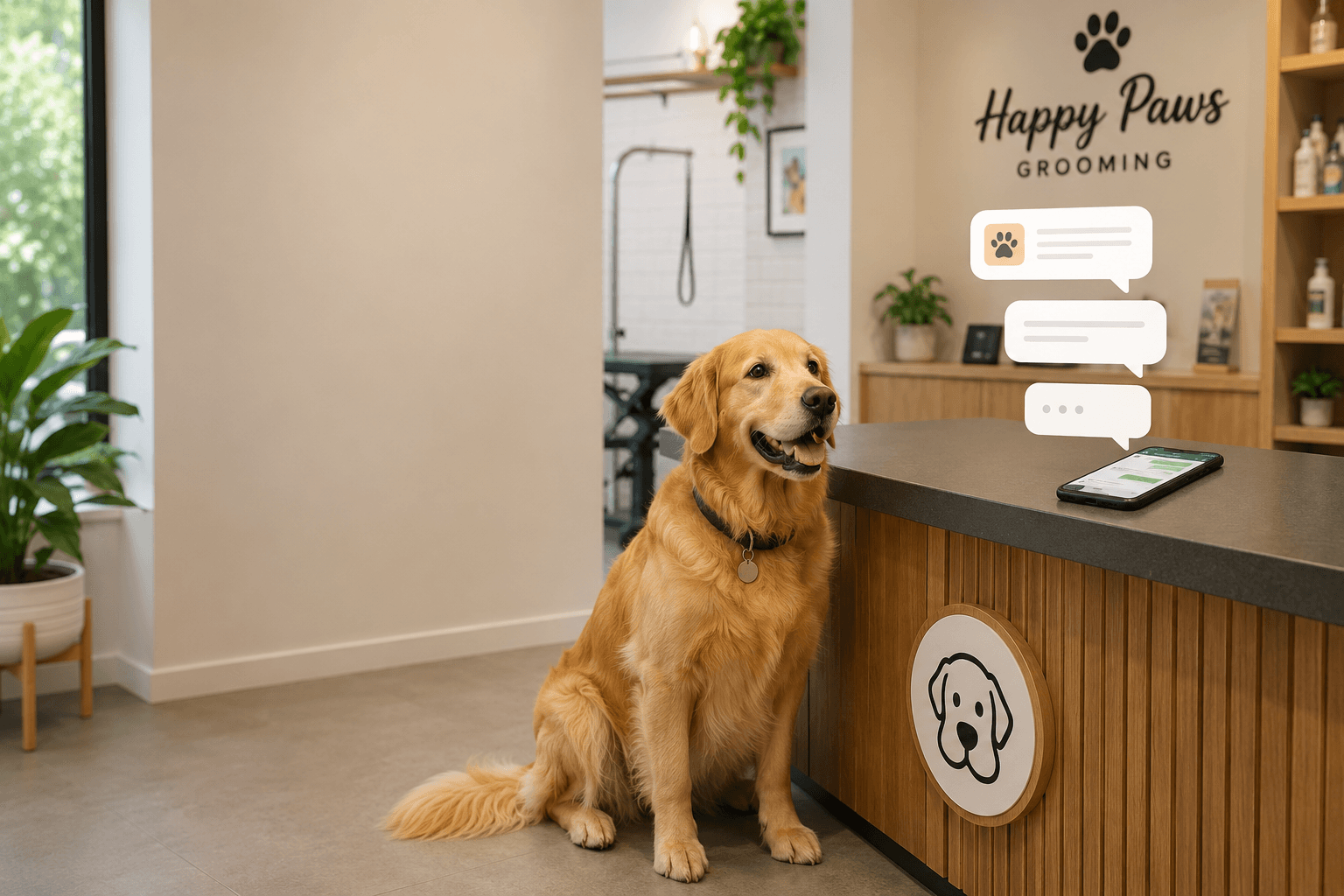
You already run your business on WhatsApp.
The booking that came in at 11pm. The payment screenshot. "Is Bruno okay?" from a nervous first-time boarder. The rebooking that happened because you happened to remember, six weeks later, that a client was probably due. None of that is a problem. WhatsApp is where your clients are, and pet parents are more comfortable messaging you about their dog than they would ever be filling in a booking form. That's an advantage. The problem is what happens when it grows. One person can hold fifty clients in their head. Nobody holds four hundred. Starts being scattered across personal and business phones.
This guide covers the six messages that make the biggest difference to a pet business, what WhatsApp automation actually costs.
How do pet businesses use WhatsApp for client communication?
Pet businesses use WhatsApp for booking confirmations, vaccination and grooming-due alerts to vaccination-due alerts and grooming reminders . Most start by sending these manually from a phone, then move to automated template messages that pull details straight from the booking system so reminders send themselves.
The two levels of WhatsApp for a pet business
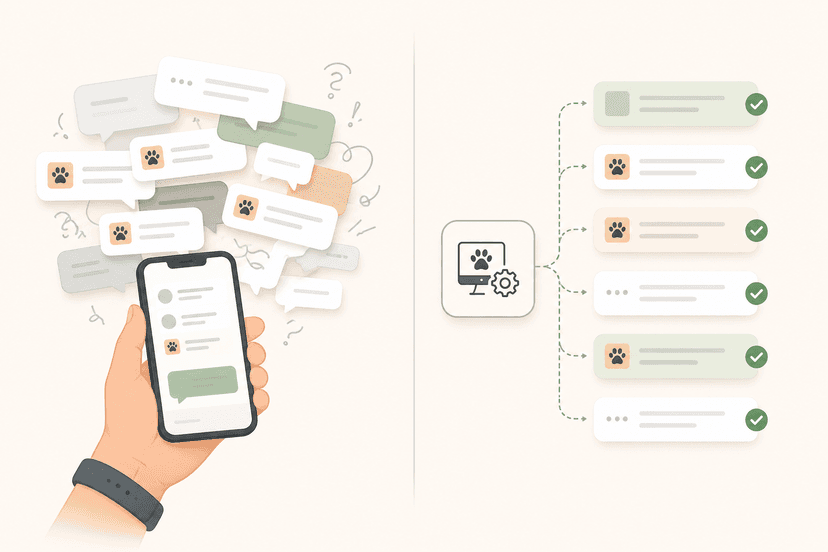
Almost every pet business is on one of two setups, and they are very different tools.
The free WhatsApp Business app
This is the green-icon app most owners start with. It's free, it takes ten minutes to set up, and it gives you a business profile, a catalogue, quick replies, labels for organising chats, and automatic greeting and away messages — the kind of basics pet grooming software eventually needs to go beyond. For a solo groomer or a single-room clinic, it is genuinely enough for a while. Quick replies alone will save you an hour a week.
Where it stops:
Broadcasts only reach saved contacts. Your client has to have saved your number for a broadcast to land. Most haven't. The list is also capped, so you can't reach everyone at once and can also turn your account down when it unsaved contacts ratio increases. Nothing sends itself. An away message is not a reminder. If nobody taps send, nothing goes out.
There's no record of sync with a booking. The conversation is on the record. When you or staff forgot to send out something is left behind
The WhatsApp Business Platform
This is the paid version, usually called the Cloud API. Instead of a phone app, your business number connects to your booking or management software. That connection is what makes everything else possible:
- Messages fire on triggers, not on someone remembering. A booking gets made, a confirmation goes out. Twenty-four hours before the slot, the reminder goes out.
- Details fill themselves in. The pet's name, the service, the time, the balance due pulled from the booking, not retyped.
- Your whole team shares one inbox. Conversations get assigned, and they stay with the business.
- You get numbers. Delivered, read, replied. You can finally tell whether reminders are actually cutting no-shows.
The trade-offs are real: you pay per message, and every message you send outside an active conversation has to use a template that Meta approved in advance. Both are covered below.
What WhatsApp automation actually costs for your pet business

This is where most people get either overcharged or scared off, so it's worth understanding properly.
Utility vs marketing: the difference that decides your bill
When you send a message outside an active conversation, it has to use a pre-approved template, and every template is assigned a category. Two of those categories matter to you:
Utility — messages about something the customer already agreed to. Booking confirmations, appointment reminders, invoices, "your pet is ready."
Marketing — promotions, offers, and anything designed to bring someone back who hasn't booked. Discounts, festival campaigns, win-back messages.
Utility messages cost a fraction of marketing messages, the gap is large, often around 80–90% cheaper depending on your country. Marketing messages also get no volume discount, which is deliberate: Meta prices bulk promotion to discourage it.
The practical consequence: five of the six messages should come utility type as per considering the nature of a pet business operation.If your bill looks high, it's almost always because templates that should be utility have been written like ads.
How to keep a reminder classified as utility
The category is decided by the template's wording, not by what you call it. A few habits keep you on the cheap side:
- Reference the specific booking, pet and date. Specificity signals utility.
- Don't mix in an offer. The moment "and get 15% off your next visit" appears in a reminder, the whole template can be reclassified.
- Keep promotional language out of transactional messages entirely — no "special," "limited time," "book now and save."
- Run offers as separate marketing templates, deliberately and sparingly.
If a template gets rejected or reclassified, it's nearly always one of those four.
What changes on 1 October 2026
Two things worth knowing if you're budgeting.
Since mid-2025, replies you sent inside the 24-hour window after a customer messaged you were free, and so were utility templates sent in that window. From 1 October 2026 both become billable per message. Free-form replies from your team or a chatbot will be charged at the same rate as utility templates in your country.
Service messages will cost the same per-message rate as utility and authentication templates in each country. Meta to publish exact rates by 1 September 2026. The free WhatsApp Business app is unaffected.
Full details are in Meta's official WhatsApp Business Platform pricing documentation.
What this looks like when it's connected to your bookings
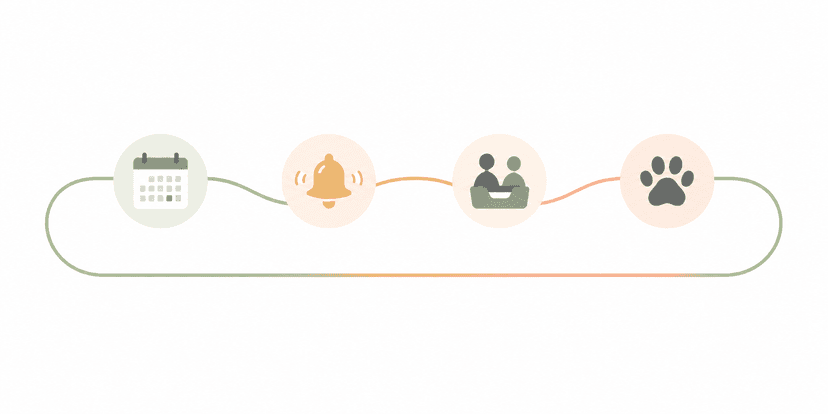
The difference between sending these messages and having them send themselves is easiest to see in one example. A client books a full groom for Friday at 3pm. The confirmation goes out immediately, with the pet's name, the service and the price already filled in, nobody typed it. Thursday at 3pm, the reminder fires. The client replies: "sorry, can we do 5 instead?"
That reply doesn't land on a groomer's personal phone or that one phone at the front desk. It lands in a shared inbox where anyone on shift can see it, pick it up and move the booking. The moment the booking moves, the 5pm slot is blocked, the 3pm slot is free for someone else, and the two-hour reminder re-schedules itself to the new time. Nobody has to remember to cancel the old one.
Friday evening, the after photo and the invoice go out together. Six weeks later, if the client hasn't rebooked, they're on the next appointment reminder list if opted, not because someone scrolled back through chats looking for lapsed regulars.
That's the actual gain. Not the messages, which you were sending anyway. The fact that the booking, the conversation and the client history are the same record, so nothing has to be remembered by a person.
This is what pet grooming software is for, and it's why the WhatsApp connection matters more than any individual feature in it.
Getting set up without breaking WhatsApp's rules
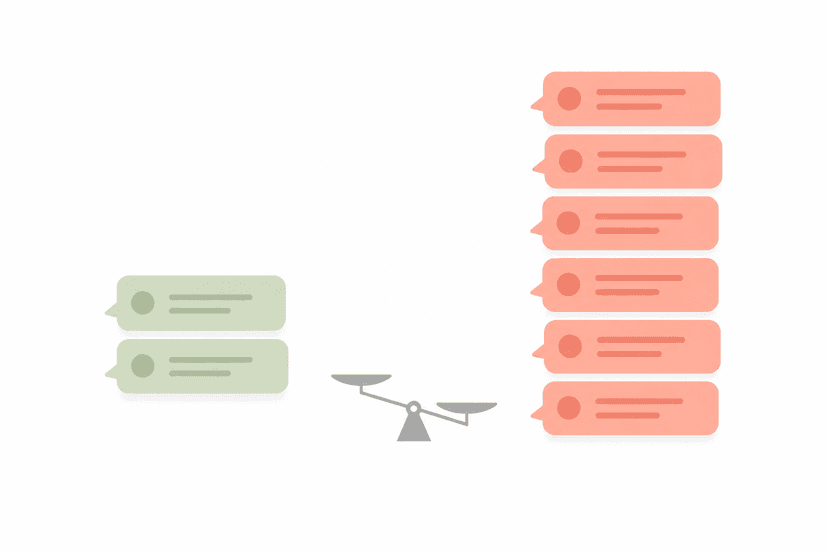
WhatsApp protects its users aggressively. Businesses that ignore this get throttled, and the throttling is invisible until you notice replies drying up.
Opt-in: what counts and what doesn't
You need permission before messaging someone who hasn't messaged you first. Counts: a tick box on your booking form, a line in your intake paperwork, a client who messaged you first, a client who scanned your WhatsApp QR code.
Doesn't count: a number you got from a walk-in and saved, a list bought from anyone, or numbers scraped from a pet group. Keep a record of when and how each client opted in. If you ever get a complaint, that record is the whole defence.
Getting templates approved the first time
Templates are reviewed before you can use them. Rejections usually come down to:
- Promotional language in a utility template.
- Missing or unclear opt-out language on marketing templates.
- Spelling and formatting errors, which get read as low quality.
Write templates the way you'd write them to a client, submit them with realistic sample values, and most go through on the first attempt.
Your quality rating and why it caps your sending
Every business number carries a quality rating based on how recipients react. Blocks and "report" taps push it down. When it drops, your daily sending limit drops with it and you'll usually notice the symptom before you notice the cause.
Three things protect it: message people who genuinely opted in, keep marketing messages rare, and make it easy to stop. A client who can opt out in one tap doesn't block you.
What you shouldn't forget when using Whatsapp for your pet business
Whatsapp business in phone is good to start with few to 20 or 30 customers still then only moves when you take a action on your own, on the other hand you always had maintained the invisible ecosystem standards from Meta,
Whatsapp business platform (Cloud API) can simply solve with the how it has been seamlessly integrated with Happy Pet Tech, when it comes with pay toll it more likely will maintain the ecosystem by itself unless you dont tamper it intentionally.
If you'd rather see the whole thing running bookings, reminders and the shared inbox connected together book a demo and we'll walk you through it with your own services and schedule.
Pricing and platform rules described here reflect publicly available information as of August 2026. Meta updates its rate card quarterly check current rates for your country before budgeting.
What pet business owners ask us most often about WhatsApp. If you're solo and handling under about fifty clients, the free app plus quick replies is fine. Once you have staff sharing an inbox, or you're big enough that manual reminders stop going out on busy days, you've outgrown it. The trigger isn't client count, it's whether the reminders actually get sent every day. For a routine visit, four is comfortable: confirmation, two reminders, and a completion message. Boarding is the exception, daily updates during a stay are welcomed, not resented, because the client is anxious. The line is roughly one marketing message a month. Beyond that, blocks start climbing. Only with recorded opt-in, and only using an approved template. If they've messaged you in the last 24 hours, you can reply freely without a template. When WhatsApp is connected to your booking system, that consent is captured at the point of booking, so you're not tracking it by hand. On personal WhatsApp, it leaves with them, and there's little you can do about it. That's the strongest practical argument for a shared business number: the conversations, the booking history and the client relationship stay with the business rather than on someone's phone. It works best for a single-person business, because you're the bottleneck. Confirmations and reminders alone give you back the evening admin hour, and the win-back message brings back clients you don't have time to chase. Still weighing it up? Book a demo and we'll set the reminders up against your own services and schedule.Frequently asked questions
Do I need the paid API, or is the free app enough?
How many messages is too many?
Can I message someone who hasn't contacted me first?
What happens to my client list if a groomer leaves?
Does WhatsApp automation work for a single-person business?
GST Invoicing for Pet Business: Things You Should Know Before Tax Filing in India (Beginner's Guide)
Aug 08, 2026
Best Pet Grooming Software in 2026: Complete Comparison Guide
Aug 06, 2026

Best Pet Boarding Software in 2026: Complete Comparison Guide
Jul 31, 2026
Features to Look for in Pet Daycare Management Software (2026 Guide)
Jul 27, 2026